
History of CWIE
Techno Park
1. Definition of CWIE (Cooperative and Work Integrated Education)
CWIE, or Cooperative and Work Integrated Education, refers to an educational approach jointly developed by higher education institutions and workplaces (government, private sectors, and communities). The objective is to produce graduates who are immediately ready for the workforce with competencies that meet labor market demands, capable of career development and future job opportunities.
CWIE is a systematic mechanism collaboratively conducted by universities and external organizations. Students will engage in Work-Based Learning, acquiring knowledge both through academic studies and real work experiences. This approach helps students develop competencies including knowledge, skills, attitudes, values, and professional attributes aligned with market needs and ready for global employment. CWIE covers various models such as Sandwich Courses, Practicum, Post-course Internships, and more.
The World Association for Cooperative & Work-Integrated Education (WACE) initiated the Global Cooperative and Work Integrated Education Charter on August 5, 2019. This global agreement encourages higher education institutions to implement CWIE to produce workforce-ready graduates and support student mobility and equal opportunities for international work-integrated learning experiences.
2. CWIE Framework and Process
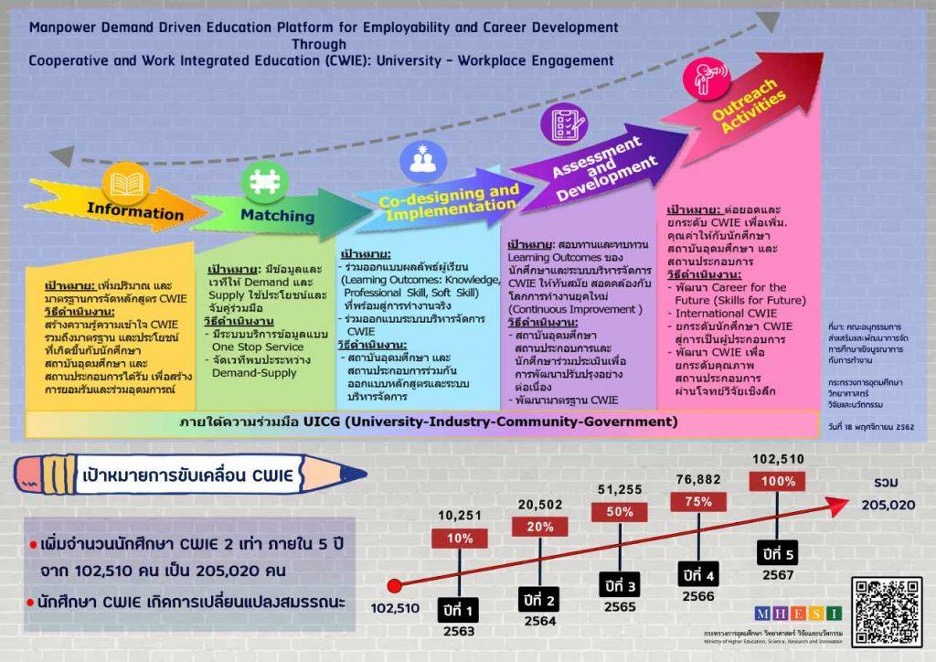
A systematic and standardized CWIE program must adhere to the Manpower Demand Driven Education Platform for Employability and Career Development through CWIE: University – Workplace Engagement, which consists of five core processes driven by collaborations among four key parties: higher education institutions, government, private sectors, and local communities.
2.1 Information: Creating mutual understanding among students, universities, and workplaces about CWIE concepts, standards, management, and benefits to ensure collective commitment and improve graduate competencies aligned with job market needs.
2.2 Matching: Connecting demand and supply through the CWIE database of the Ministry of Higher Education, Science, Research, and Innovation. This platform provides information about curricula, student numbers, workplaces, job positions, required competencies, remuneration, and employment tracking.
* External organizations refer to government agencies, industries, private sectors, civil society, and communities (according to the Higher Education Act B.E. 2562, Sections 28 and 35).
2.3 Co-designing and Implementation: Designing the curriculum and defining student outcomes collaboratively. This includes preparing students, mentoring systems, workplace supervision, competency assessment, remuneration, welfare, and safety systems.
2.4 Assessment and Development: Evaluating student outcomes and management systems for continuous improvement through the PDCA (Plan-Do-Check-Act) cycle.
2.5 Outreach Activities: Advancing CWIE through initiatives such as Career for the Future, International CWIE, entrepreneurship development, and joint research to upgrade external organizations.
3. Key Principles of CWIE (4 Key Characteristics)
3.1 University – Workplace Engagement: Strong collaboration between universities and workplaces to produce graduates ready to meet current and future labor market needs.
3.2 Co-design Curriculum: Joint curriculum design focusing on student competencies and balancing academic, professional, and life skills.
3.3 Competency-based Education: Competency-focused teaching and assessment aimed at problem-solving and systematic evaluation of student capabilities.
3.4 Experiential-based Learning: Real-world work experience combined with performance evaluation and workplace learning processes.
4. CWIE Program Models
4.1 Separate Model: Students complete academic coursework before undertaking workplace practice, e.g., cooperative education.
4.2 Sandwich Model: Students alternate between academic study and real-world practice during the entire program, e.g., Sandwich Program.
4.3 Mixed Model: A combination of academic study and concurrent workplace practice, integrating features of the Separate and Sandwich models, e.g., work-based learning programs like the Samui Model.
All CWIE models require cooperative learning management between higher education institutions and workplaces.
5. Definitions
Workplaces: Government agencies, state enterprises, public organizations, business sectors, industries, manufacturing, services, and communities.
Workplace Supervisor: Personnel responsible for mentoring, advising, and instructing students during workplace practice.
Faculty Supervisor: Academic staff responsible for guiding students academically and professionally, monitoring their progress, and supervising academic reporting.
Prepared by: CWIE Unit, KMUTNB Techno Park | Tel. 02-555-2000 Ext. 1777